AI orchestration: the new workflow layer in software development
Once several agents work in parallel, the prompt is no longer the main problem. The important parts are the brief, the hand-offs, and where a person takes responsibility again.

Four agents work on one ticket at once. One writes code, one adds tests, one searches the repository, and one writes the summary. An hour later there is a lot of output. What is often missing is the one answer the team needs: what is true now, what is only a proposal, and who checks the transition?
That is not a model problem. It is a workflow problem. Individual coding assistants such as GitHub Copilot, Cursor, Aider, and Claude can already be useful in production. When several runs, branches, and sessions happen at once, though, a good assistant is not enough. The work needs choreography.
AI orchestration is that unglamorous but important layer. It keeps an idea from ending as a large AI-shaped blanket and turns it into a traceable sequence of brief, workspace, evidence, and hand-off.
Do not distribute agents. Slice responsibility.
The common false start is: “Let’s divide the task across four agents.” That is not orchestration yet. Parallel work helps only when its boundaries are clear.
A useful brief is smaller than a feature request. It contains an observable outcome, a boundary, and a way to verify it. Not “build the new invoice view”, but “add the total row in component X, do not change calculation logic outside that module, and provide a test that reproduces the old fault.”
With that brief, agents can work without silently inventing architecture decisions. A reviewer can later assess whether the result matches the brief instead of guessing their way through a clever-looking implementation.
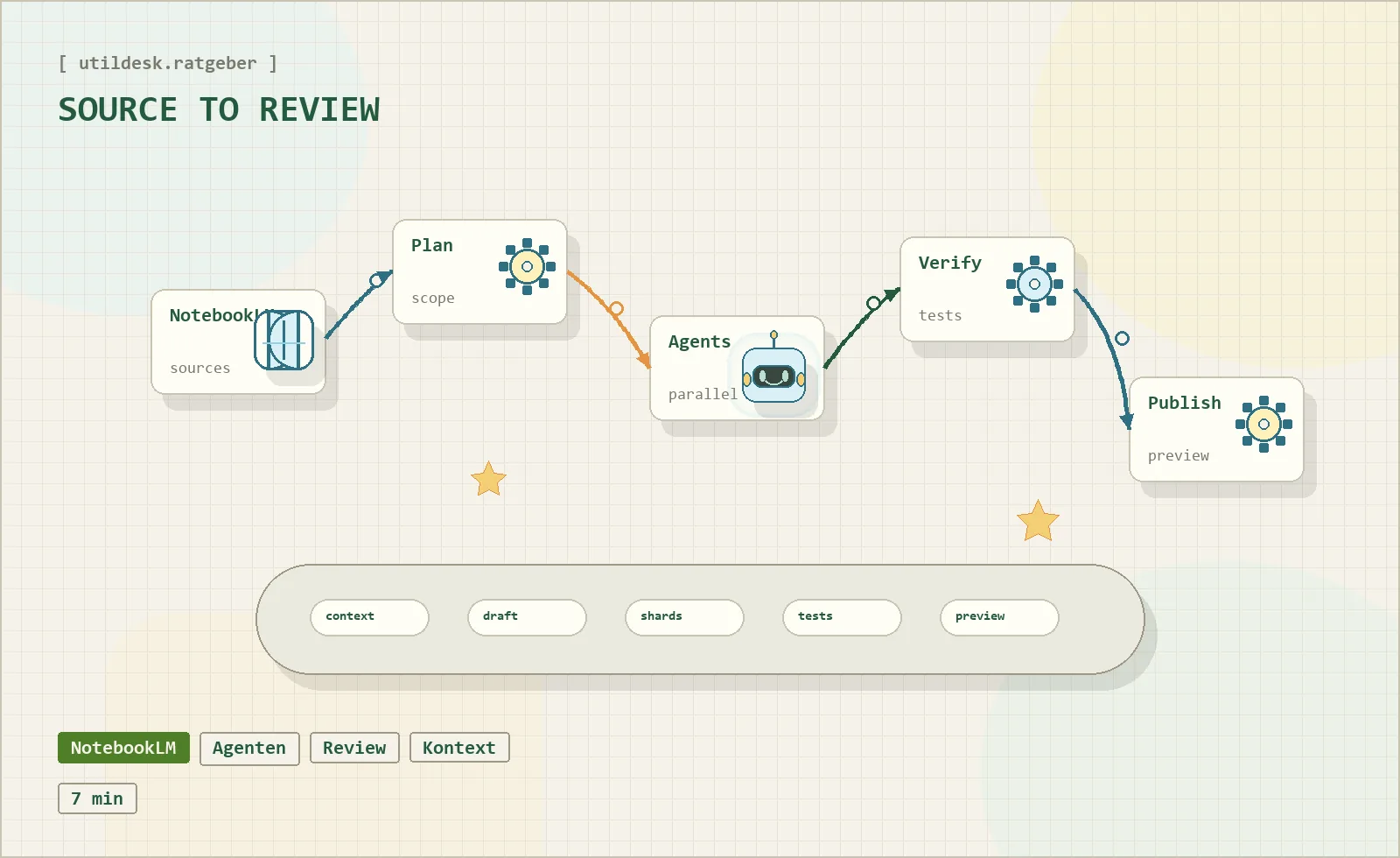
Four stations that actually help
A resilient flow does not need an agent factory. It needs four stations that every change passes through.
1. The brief. A person or clear product decision states what should change, what must not change, and how success is recognised.
2. The isolated workspace. An agent changes a separate branch or worktree, not the shared mess. Git worktrees are no longer an exotic trick: they allow parallel working trees without agents overwriting one another’s files. The Git documentation describes the mechanism.
3. The evidence. Tests, linters, screenshots, or a reproducible command show what was checked. A green run does not automatically prove that the job was solved correctly. Without evidence, however, even a plausible diff is merely a claim.
4. The hand-off. A person or explicit policy decides whether the result may enter the shared codebase. Good orchestration does not eliminate this moment. It makes it easier because the context, diff, and evidence are together.
Orchestration often begins before the framework
Frameworks such as LangChain and CrewAI help coordinate agents, tools, and state. LangGraph focuses on durable, stateful agent workflows; Temporal is built for resilient workflows that can resume after failures. They are useful building blocks when processes run for longer or cross several systems.
In day-to-day development, the first orchestration layer is usually simpler: a good issue, a clean branch, a work record, and a review rule. Without those, a multi-agent framework only produces hard-to-review work faster.
The right order is therefore to make the workflow and responsibilities visible first, then decide whether a framework solves a recurring problem.
A bug fix without agent theatre
Imagine an export that fails on empty fields. One agent may search the repository and document the likely path. A second works on a small patch and regression test in a separate worktree. A third only compares the diff with the original brief: was an assumption added, was too much rebuilt, and does the test actually fail before the fix?
This seems like more steps than “Agent, fix it.” In practice it saves time because unavoidable uncertainty appears early. Review becomes shorter, rollback clearer, and the next session can resume where the previous one stopped.
What bad orchestration looks like
The signals are reliable: every agent receives the same open-ended request; they share one working tree; results are handed over only as a long chat summary; tests run somewhere but nobody knows against which expectation; and in the end a human is asked to nod through a huge diff.
That is not automation. It is context displacement. The work has not disappeared; it arrives later and more expensively in review.
Good orchestration does the opposite. It increases the number of small, inspectable decisions and reduces the number of large surprises. That is why it is less a technology choice than a team discipline.
The next useful experiment
Choose a task that can be reviewed in one or two hours. Define success and boundaries in three sentences. Let one agent analyse, a second patch in an isolated workspace, and a person inspect the evidence. Measure not only duration. Measure whether the reviewer understands what happened faster.
If it works, the team can extend the same structure to longer runs, resumability, and several services. If it does not, the lesson is still useful: the number of agents does not need to rise; the clarity of the brief does.