Quick verdict
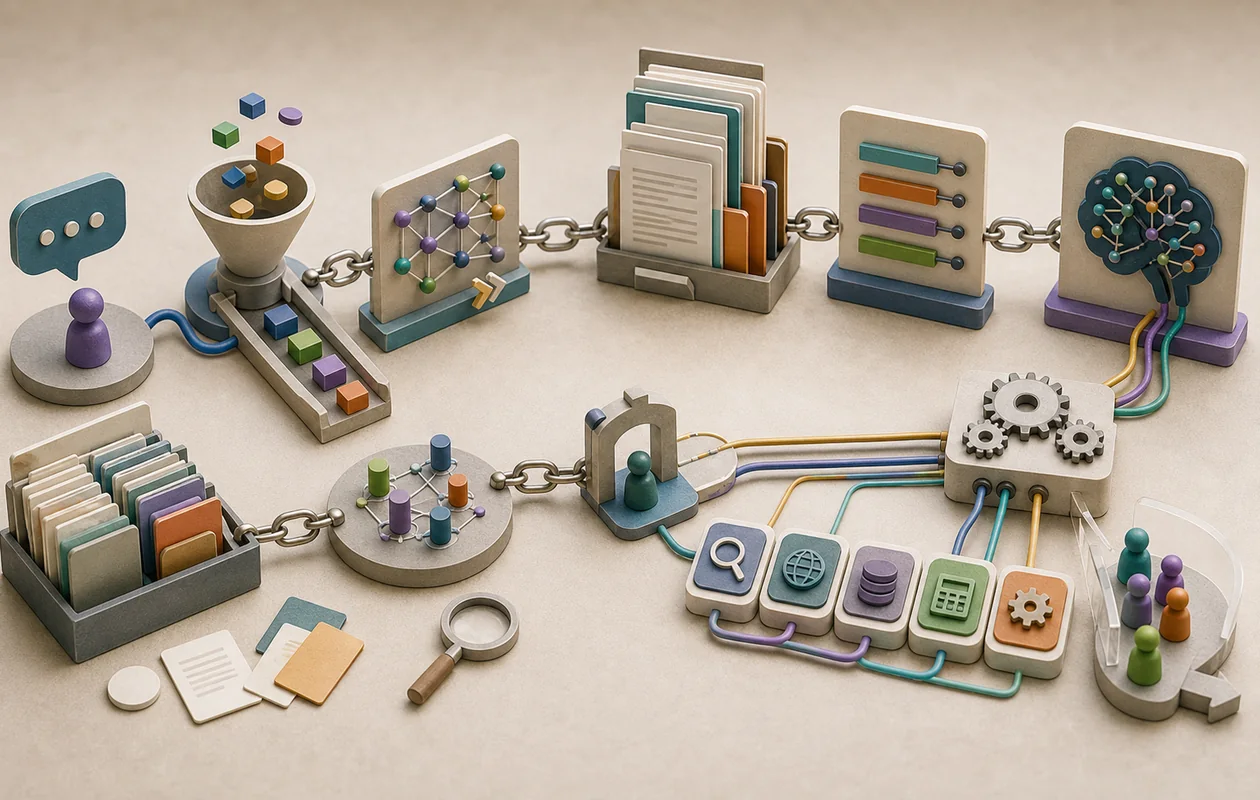
A support agent receives: “My order was charged twice; refund it immediately.” A simple chatbot can answer politely. A production application must retrieve customer data, distinguish transactions, draft a response, and stop before issuing a refund. LangChain is relevant precisely for this connection among a model, tools, state, and control points.
LangChain provides higher-level agent and integration components; LangGraph is the runtime for long-lived, stateful workflows with persistence and human-in-the-loop; LangSmith adds tracing and evaluation. We recommend the stack when a team is building a real LLM application and can deliberately operate the added abstraction. For a single prompt or small API function, it is unnecessary scaffolding.
What LangChain is today
LangChain is an open-source framework for applications that connect language models to data sources, tools, and workflow logic. Prebuilt agent patterns simplify common model and tool loops. Teams needing more control over state, interruptions, and long-running tasks work with LangGraph.
LangGraph persists state through checkpoints. A workflow can resume after failure, remember across sessions, inspect an earlier state, or pause for a human decision. LangSmith records runs, supports evaluation, and helps explain why an agent selected a particular sequence of tools.
A realistic support workflow
For the duplicate payment, a first step reads only approved order and transaction data. The model does not classify the case from prose alone; it receives structured results from the systems. If two payments are present, the agent proposes a refund action with an amount and reason.
The action does not run immediately. A human-in-the-loop rule interrupts the graph before the writing tool. The responsible employee can approve it, edit the amount or text, or reject it. State remains persisted and the workflow resumes after the decision. LangSmith can then show which data and tool calls led to the outcome.
The architectural point is separation: the model proposes, deterministic components enforce boundaries, and approval protects the consequential action. LangChain makes that process buildable; it does not design it on the team's behalf.
Who is LangChain for?
- Development teams connecting models to databases, APIs, search, and internal tools
- Product teams that need to observe and evaluate agents, not merely demonstrate them
- Applications requiring long-running state, resumption, or human approvals
- Teams keeping model providers replaceable and reusing integrations
- Prototypes that are expected to grow into controlled production workflows
LangChain is less suitable when a direct SDK call reliably solves the entire task or nobody owns runtime, traces, and evaluation.
Typical use cases
- Tool-enabled agents: Give models controlled access to APIs, search, or databases.
- Retrieval applications: Find internal documents, turn them into context, and prepare source-grounded answers.
- Long-running workflows: Persist state and resume after failures or waiting periods.
- Approvals: Pause writing or risky tool calls before execution.
- Tracing and evaluation: Inspect runs and measure variants against test cases.
- Model abstraction: Change providers without restructuring the whole application.
Strengths
- Broad ecosystem of models, tools, retrievers, and integrations
- LangGraph explicitly supports persistence, interruption, and resumption
- Human-in-the-loop can approve, edit, or reject tool calls
- LangSmith exposes agent paths and evaluation
- Useful on the path from experiment to reviewable application
Limits and risks
- More abstraction means more concepts, versions, and debugging layers
- Ambiguous state or tool contracts remain unreliable even with a framework
- Traces may contain sensitive prompts, data, and tool results
- The integration catalog can encourage architecture before a real problem exists
- Model and tool costs can accumulate invisibly through loops and retries
Workflow fit
Start with one measurable workflow and explicit states. Define inputs, permitted tools, stop conditions, approval points, and output format before an agent receives discretion. Production interruptions require a persistent LangGraph checkpointer; in-memory state is appropriate only for tests.
Evaluation should not be postponed. A small set of normal cases, edge cases, and deliberate tool failures quickly shows whether a prompt or model change actually improves the workflow.
Privacy & operations
Prompts, retrieved documents, tool arguments, state, and traces may contain confidential data. Access, encryption, retention, and deletion need to be defined for checkpoints and observability as carefully as for the model. Production tools should receive minimal permissions and separate read from write paths.
External models and services add their own contractual and data terms. A framework is not a privacy guarantee; it only makes flows easier to structure.
Pricing & costs
The core framework components are open source. Costs come from models, vector stores, databases, hosting, and optional LangSmith or platform services. The meaningful unit is a successfully completed and reviewed task, not one model call.
Go to provider: https://langchain.com/
Editorial assessment
Editorial verdict: With caveat.
LangChain is neither a magic wand nor merely “prompt chaining.” The stack becomes valuable when a team treats state, tools, approval, and evaluation as product components. Teams with that discipline get a powerful foundation. Teams without it can only fail with more complexity.
Editorial verdict: Recommended for serious tool-enabled LLM applications with clear operational ownership. Not recommended as the default answer to every small AI feature.
Open frequently asked questions
FAQ
What is the difference between LangChain and LangGraph?
LangChain provides higher-level agent and integration components. LangGraph is the runtime for stateful, long-lived workflows with persistence and interrupts.
What is LangSmith for?
It supports tracing, evaluation, prompt work, and operational observation of LLM and agent workflows.
Can an agent be stopped before an action?
Yes. Human-in-the-loop rules can interrupt selected tool calls; a person can approve, edit, or reject them.
Why does LangGraph need a checkpointer?
It persists state so a workflow can resume reliably after a pause or failure.
Is LangChain available only for Python?
Important implementations and documentation exist for Python and JavaScript/TypeScript. Feature details may differ.
Do I need LangChain for RAG?
No. Retrieval can be built directly with provider SDKs and databases. LangChain is useful when its reusable components simplify the actual workflow.
Is LangChain free?
The frameworks are open source. Models, hosting, databases, and optional platform services may cost money.
When should a team avoid it?
When a direct API call is enough, no long-running state is required, or nobody can own the framework and evaluation.