Quick verdict
A strategy team needs a market briefing by tomorrow. One agent should find sources, a second should check figures and contradictions, and a third should write the readable version. It sounds like a digital newsroom, but it fails quickly when three roles copy the same unsupported claim from one another. CrewAI becomes useful when roles receive not only names, but different tools, inputs, expected outputs, and validation criteria.
CrewAI distinguishes Crews for collaborative, open-ended agent work from Flows for controlled, event-driven execution with state and branches. We recommend the framework for developers who deliberately model and observe multi-agent work. Three prompts executed in sequence do not need a crew.
What CrewAI is today
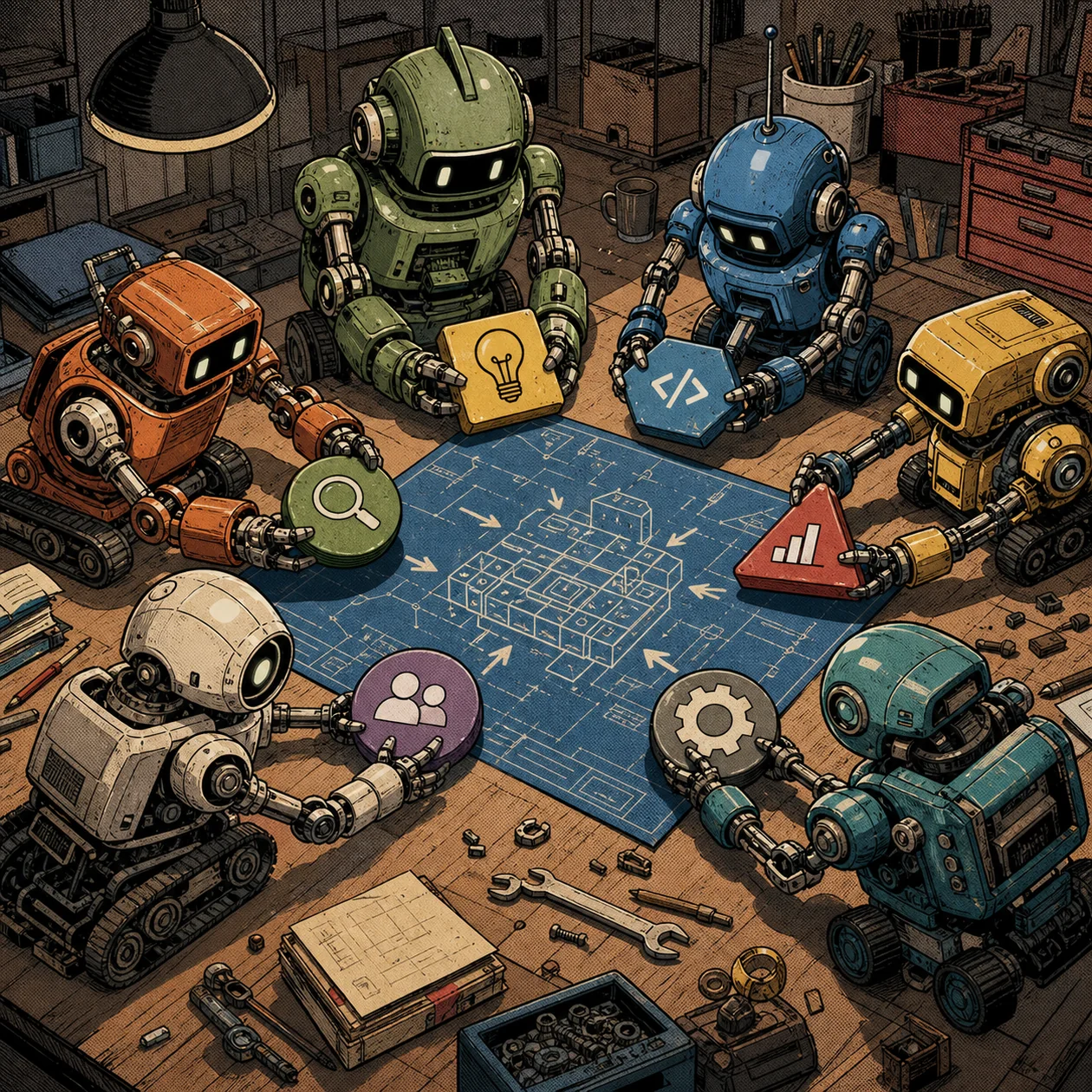
CrewAI is an independent open-source Python framework for agents, tasks, crews, and flows. An agent receives a role, goal, tools, and context; tasks define assignments and expected outputs; processes determine the sequence or hierarchy of collaboration. Crews suit exploratory work where specialized agents exchange information.
Flows provide the more deterministic frame. They react to events, manage state, branch explicitly, and can invoke a crew only where open problem solving is actually required. Persistence, guardrails, callbacks, and human-in-the-loop triggers help turn a demo into a reviewable workflow. CrewAI also offers a managed platform for deployment and observation.
A realistic briefing workflow
In the market briefing, no agent begins with prose. A flow first validates the input, time period, and approved sources. The research agent must then return original sources with date and URL in a structured schema. The analysis agent may use only that schema, marks conflicting figures, and expresses uncertainty explicitly.
The writing agent turns this material into a briefing but may not add a new fact. A guardrail checks that each central claim carries a source ID. Missing evidence sends the task back. Before export or delivery, the flow pauses so a person can sample the sources, review the tone, and approve the conclusion.
The value does not come from simulated job titles. It comes from separated responsibility. Each handoff has a format; each role sees only the necessary tools; the flow owns the error path and completion state.
Who is CrewAI for?
- Python teams coordinating specialized agents in one process
- Research, analysis, and content applications with clearly separable roles
- Developers embedding autonomous subtasks in a controlled flow
- Projects using structured output, guardrails, and human approval
- Teams that must deploy, observe, and reproduce multi-agent runs
CrewAI is less suitable for a simple automation with one model call, an ambiguous task without a measurable result, or a team without Python and operational ownership.
Typical use cases
- Research crews: Collect sources, inspect evidence, and edit the report as separate tasks.
- Content pipelines: Model briefing, draft, fact-check, and approval explicitly.
- Support triage: Classify cases, enrich context, and prepare only permitted actions.
- Data analysis: Coordinate specialists for extraction, analysis, and explanation.
- Hybrid workflows: Let a flow control the process and a crew solve only the open part.
- Enterprise automation: Start agents from triggers and monitor executions.
Strengths
- Understandable model for roles, tasks, crews, and flows
- Clear distinction between open agent work and deterministic orchestration
- Structured output, guardrails, and callbacks can be explicit
- State and resumption support longer-running processes
- Open-source framework plus an optional platform for deployment and observation
Limits and risks
- More agents usually mean more cost, latency, and failure handoffs
- Role descriptions alone do not prevent hallucinations or circular reasoning
- Delegation becomes difficult to inspect when tasks are not bounded
- Tools and external actions need minimal permissions and clear stop conditions
- A polished final report can conceal poor intermediate sources
Workflow fit
The best starting point is a flow with one crew invocation. Define the input schema, allowed sources, task outputs, maximum loops, error paths, and approval point first. Add another role only after this workflow works measurably.
Evaluation needs more than “looks intelligent.” Measure source errors, repeated work, cost per accepted output, runtime, and the share of cases requiring human correction.
Privacy & operations
Every agent and tool expands the data and permission surface. Roles should receive only the information their task needs. Prompts, intermediate results, state, and traces may contain confidential data and need retention and access policies.
External models add their own data terms. Self-hosting the framework does not mean that model calls or connected tools remain local.
Pricing & costs
The framework is open source. Models, tools, storage, hosting, and the managed CrewAI platform can add cost. Multi-agent workflows multiply calls easily, so teams should measure cost per accepted final result rather than per agent.
Go to provider: https://www.crewai.com/
Editorial assessment
Editorial verdict: With caveat.
CrewAI makes multi-agent systems understandable to model, but not automatically worthwhile. The productive core is usually a controlled flow with a few tightly bounded agent roles. If one agent solves the task equally well, it is almost always easier to test and operate.
Editorial verdict: Recommended for genuinely collaborative agent processes with structured handoffs and observability. Not recommended when “more agents” merely makes a demo look more impressive.
Open frequently asked questions
FAQ
What is a crew?
A group of specialized agents working on defined tasks in a shared process.
What is a flow?
An event-driven, controlled workflow with state, branching, and explicit execution paths.
When should I use a crew rather than a flow?
Crews suit open research and collaboration. Flows suit auditable decisions, API orchestration, and deterministic paths.
Can they be combined?
Yes. A flow can govern the overall process and start a crew at one selected point for open problem solving.
Does CrewAI support structured output?
Yes. Tasks and agents can use structured results, including Pydantic models.
Are guardrails available?
Yes. Defined checks can validate results and reject or retry invalid output.
Is human-in-the-loop possible?
Yes. Human review points can be included in tasks and flows; the exact implementation should be tested for the workflow.
Is CrewAI open source?
The framework is open source. Managed deployment and additional platform functions are separate offerings.
Do I need Python?
For practical framework use, yes. No-/low-code platform functions do not replace every technical operations task.
How many agents should I start with?
As few as possible. Each additional role needs a demonstrably distinct task, defined input, and reviewable output.
What should a pilot measure?
Source and task quality, runtime, cost, retries, human correction, and reproducibility.