Is Your Website Ready for AI Agents? Three Decisions Instead of AI SEO Panic
Agent-ready is not one feature: discoverability, machine-readable content and executable actions need separate rules.

A product team hears that agents are shopping on the web. By afternoon it has an llms.txt, a chatbot and an API key. The site is neither easier to discover nor safer. “Agent-ready” sounds like a feature; it is a set of distinct decisions.
Be found, be understood, be allowed to act
Search systems need canonical URLs, a maintained sitemap, reachable content and no conflicting index rules. A sitemap is a hint, not admission to an AI answer.
Machines must also understand content. Clear HTML, useful headings and structured data help more than an exotic root file. Markdown or JSON mirrors can support technical users but do not replace good pages.
Acting is a third category. An agent may search a public catalogue or prepare a draft. An order, account change, ticket deletion or pricing approval needs independent confirmation.
Audit ten pages
Check ten important URLs: do they return 200, point to themselves, state one clear subject and avoid broken links? Then inspect the machine surface: is essential content readable without a JavaScript experiment; does structured data explain something real; are feeds and APIs deliberately noindex but reachable?
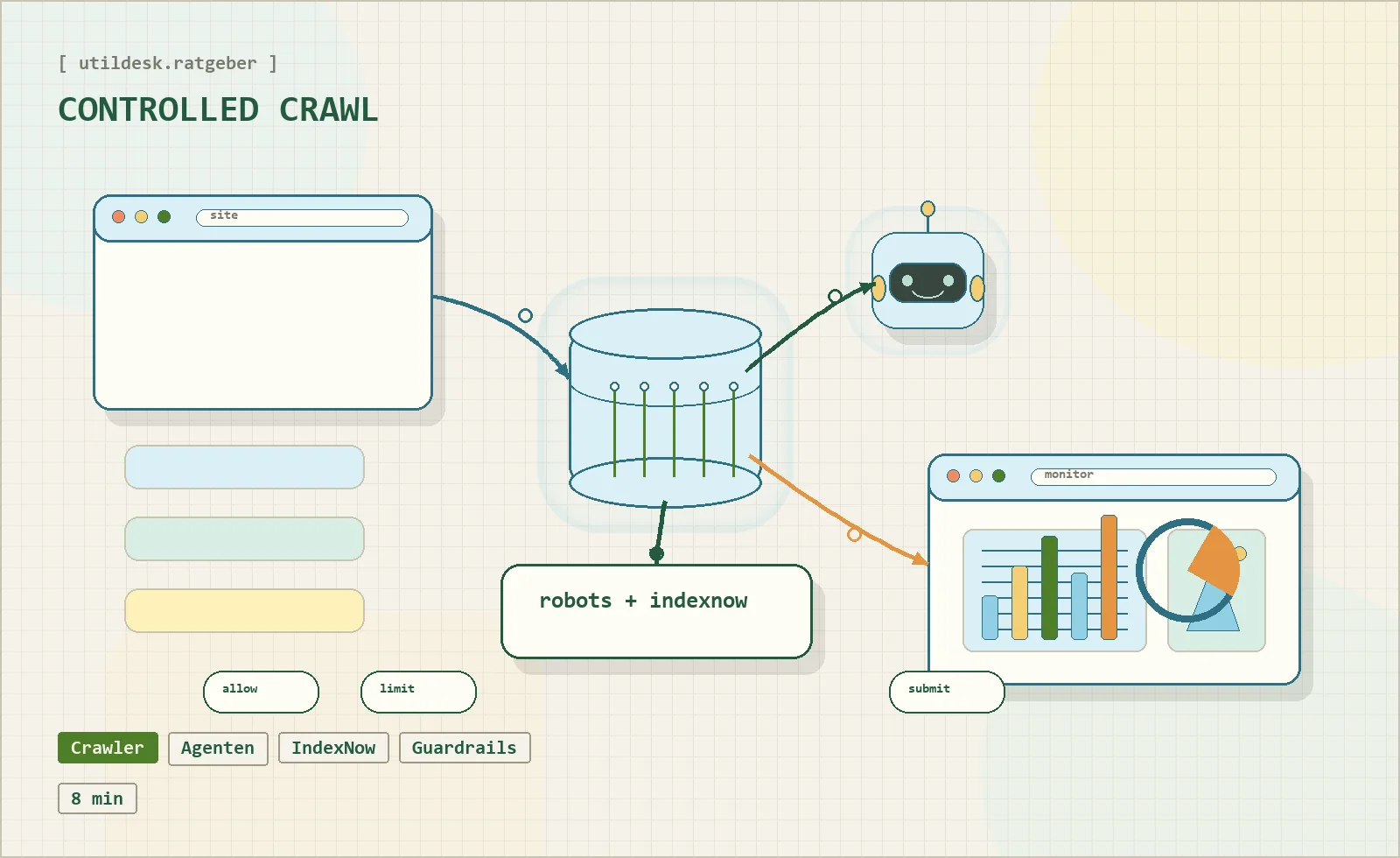
Control crawlers instead of guessing
Logs and CDN analytics show actual load better than stories about AI traffic. Separate known search bots, documented AI crawlers and unknown automation. Rate limits, caching and WAF rules protect against abuse; robots.txt is not access control. Public content should be stable and fast; private data needs authentication and server-side permissions.
Start agents safely
Begin with a read-only task: a public help centre, product comparison or support draft. Limit domains, fields and rate; log what was read and proposed. Only then add a harmless write action with a visible preview.
For critical steps, the agent may plan but a person or backend check approves. That protects against prompt injection and your own mistaken assumptions.
Conclusion
An agent-ready site is not a visibility trick. It is a maintained public surface with clear boundaries: content is findable and understandable, data access is intentional, actions are narrow and risky steps need confirmation.