Persistent AI memory 2026: how AI keeps context across sessions, projects and models
Persistent AI memory decides which context an assistant may keep. This guide separates platform memory, project context, agent state and external memory layers.

AI assistants are not only becoming more useful because models are stronger. They are becoming more useful because they no longer have to pretend that every new conversation is day one. But the key question is not: Can the AI remember? It is: Which memory may reappear in which context, who can review it, and when must it disappear?
That is why persistent AI memory has become an architecture topic in 2026. ChatGPT stores personal preferences and project context, Claude is expanding memory for work accounts and code projects, Gemini connects personal context signals with notebooks, and frameworks such as LangGraph treat state as controllable infrastructure. At the same time, memory layers such as Mem0, Letta and Zep try to make memory portable beyond a single chat window.
That sounds like convenience. In practice it is responsibility. A wrong memory can be worse than a forgotten hint because it quietly leaks into later decisions. Good memory does not simply make an assistant "more personal". It makes visible where context came from, what boundary it has and where a human has to intervene.
Four layers of AI memory
People often use the word memory for several different things at once. Tool selection gets easier when those layers are separated:
| Layer | What persists? | Typical tools | Good use | Risk |
|---|---|---|---|---|
| Personal memory | preferences, work style, recurring instructions | ChatGPT, Claude, Gemini | the assistant does not start from zero every time | private preferences leak into the wrong tasks |
| Project memory | goals, files, earlier decisions, conversation context | ChatGPT Projects, Gemini Notebooks, NotebookLM | long-running topics stay coherent | old project knowledge overrides new facts |
| Code and repository memory | rules, architecture, commands, local conventions | Claude Code, OpenAI Codex, agent setups | less prompt repetition and more consistent diffs | instructions are mistaken for safety boundaries |
| Agent state and external memory | checkpoints, facts, graphs, retrieval history | LangGraph, Mem0, Letta, Zep | inspectable agent runs and reusable knowledge | memory becomes an uncontrolled shadow database |
This distinction matters more than whether a provider calls the feature "Memory", "Projects", "Notebooks", "Threads" or "Knowledge Graph". A personal writing preference should not live in the same store as deployment rules. A team decision from one project should not automatically become private assistant memory for one person. And an agent checkpoint is not permission to carry old assumptions forever.
Platform memory: convenient, but not unlimited
For the major assistants, memory is now part of the product promise. OpenAI describes ChatGPT memory as a way to retain preferences, projects and recurring constraints across conversations. With the 2026 "dreaming" architecture, memory is also becoming more curated: the assistant can distill past conversations in the background and expose a visible, reviewable memory summary.
That is useful for people who work with ChatGPT every day. Tone, project goals, favorite output formats and no-go rules do not have to be retyped constantly. But it also makes operation more demanding. If memory is enabled, users should regularly review what was stored. An old preference such as "always answer briefly" can hurt analysis work. An old project assumption can become wrong in a later phase.
The same applies to project boundaries. ChatGPT Projects can bundle conversations, files and instructions around a topic. OpenAI also describes project-only memory, where a project should not draw on broader personal context. For teams, that boundary is valuable: a project needs continuity, but not automatically every private memory of a user.
Claude is moving in a similar direction, especially at work. Anthropic positions memory as a way to pick up tasks, preferences and ongoing projects. For code work, Claude Code adds another form of memory: CLAUDE.md files and automatic memory are loaded so an agent can reuse project knowledge, commands and conventions without relearning them from scratch.
The important caveat is stated more clearly in the Claude Code documentation than in many marketing pages: instructions are context, not a hard technical boundary. If an agent must be prevented from taking certain actions, teams need real hooks, permissions, sandboxes or reviews. Memory is not a policy engine.
Project memory: notebook, not endless chat
The second strong trend is project-bound memory. With Gemini Notebooks and NotebookLM, Google moves a lot of context work into notebooks: earlier chats, documents, PDFs and sources become a topic space that can be revisited later. This is less "the assistant knows me" and more "this topic has a memory".
For research, content, product decisions and technical dossiers, that is often the better shape. A notebook can be narrower than personal memory. It can gather sources, expose contradictions and mature into a briefing without writing everything into the assistant's general personality.
For guides, comparisons and market analysis, that separation is healthy. A NotebookLM source can help structure raw material. The editorial decision remains human: Which claim is supported? Which number is too thin? Which vendor source smells like PR? Which internal link actually helps the reader?
The best project memory is not a data graveyard. It is a workspace with an expiration rhythm: add sources, sort notes, extract a briefing, write the article, mark open questions and remove stale assumptions.
Agent memory: state must be repeatable
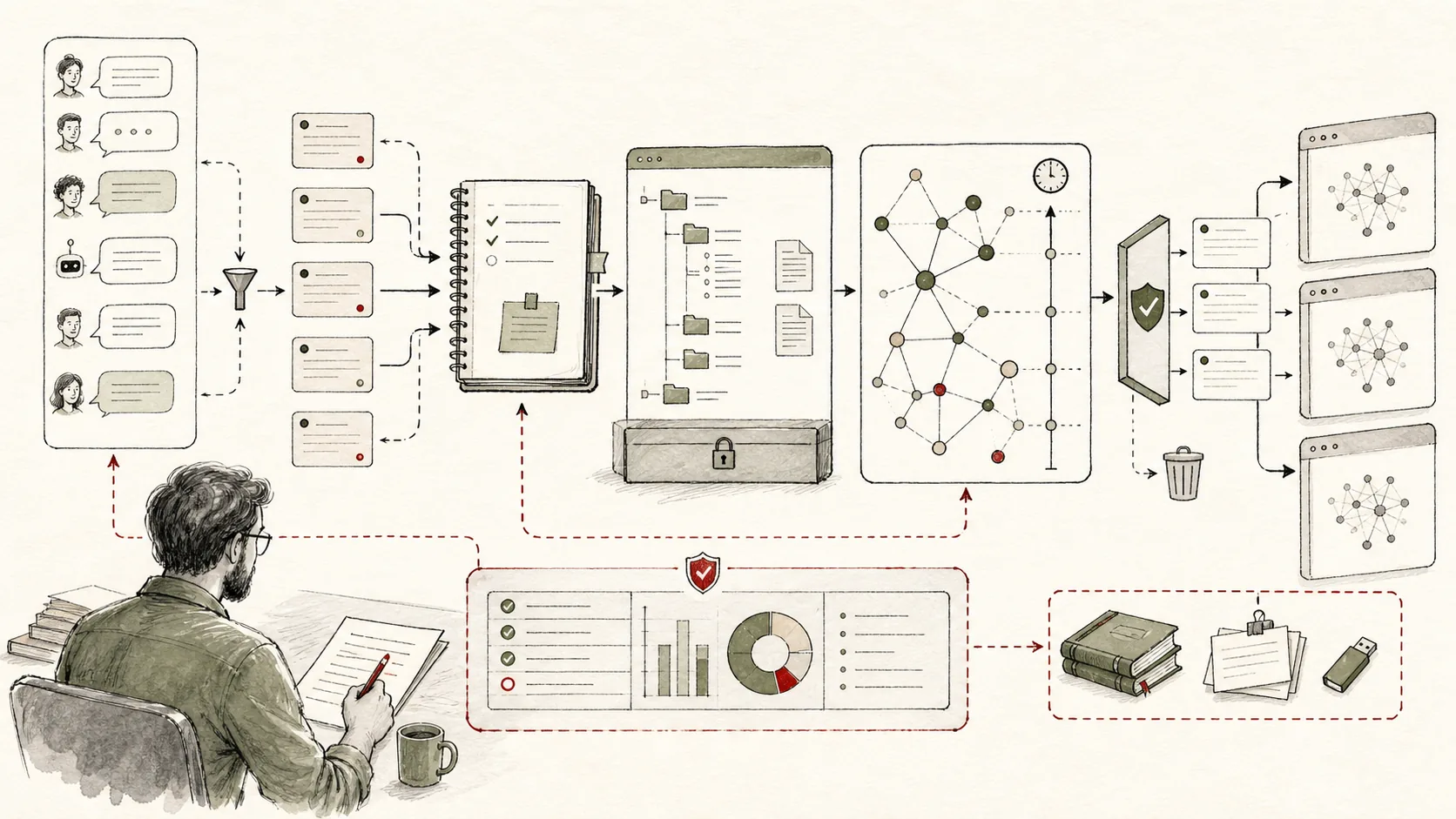
With agents, memory becomes more concrete. An agent that uses tools, writes files or plans across several steps does not only need memories. It needs state. It has to know which step is done, which decision was made, which data is uncertain and where a human approved the next move.
LangGraph handles this through persistence and checkpointers. A graph can save state at defined points and resume later through a thread ID. That is less glamorous than a chatbot with long-term memory, but it is closer to production reality. If an agent run is interrupted, teams need to know which nodes already ran and which context truly belongs in the next step.
Mem0 approaches the problem from the other side: memory as a dedicated layer that turns conversations and interactions into reusable context. Such systems become interesting when several agents, models or applications need to draw on shared knowledge. Letta uses a more file-based approach with a git-style memory filesystem. Zep models memories as a temporal graph with facts, nodes and relationships so changes over time can be represented.
The shared direction is clear: memory is moving out of the single chat window. It is becoming infrastructure that has to be versioned, reviewed, deleted and migrated. That raises the bar. Teams that introduce external memory layers should treat them like databases: with data classification, deletion logic, access control, tests and monitoring.
What good memory looks like
Good AI memory does not simply make everything longer. It improves selection. A useful system can answer five questions:
- Scope: Is this memory personal, project-specific, team-wide or system-level?
- Source: Did it come from a chat, a file, a tool run, a human decision or an external source?
- Freshness: Is the memory still valid or merely historical context?
- Retrieval rule: When may it flow back into a prompt or agent run?
- Deletion: How can it be corrected, disabled or removed?
Bad memory is the opposite. The assistant suddenly "knows" things but cannot explain where they came from. Old preferences appear in the wrong tasks. Team decisions get mixed with personal habits. Nobody knows whether a wrong memory was deleted or merely covered by a newer one.
A practical roadmap for teams
Small teams can start with a simple but strict order:
- Enable personal memory deliberately: Store only what recurs often: writing style, preferred output formats, taboos, working rhythm.
- Separate projects: Use ChatGPT Projects, Gemini Notebooks or NotebookLM for long-running topics instead of mixing everything into one endless main chat.
- Version repository rules: Code agents should read project rules from visible files, not guess them from spoken memory.
- Make agent state explicit: For multi-step workflows, define checkpoints, logs and resume points.
- Schedule memory audits: Review what is stored, what is stale and what must be removed for privacy reasons.
For production agents, add a sixth rule: memory must not simulate safety. If an agent is not allowed to touch customer data, "please do not use customer data" is not enough. It needs permissions, network limits, tool filters or review gates.
That also matters for tools such as Hermes Agent and OpenClaw. Both are compelling because they bring agents closer to daily work. That is exactly why they need clear memory and tool boundaries. If an agent lives inside messaging channels, local tools or longer automations, teams should decide first which memory is allowed to travel with it.
Conclusion: memory is the new prompt
In 2023 and 2024, many teams learned to write better prompts. In 2026, the question is shifting: not every context belongs in the prompt, and not every memory belongs in the future. Persistent AI memory is the attempt to store recurring knowledge so an assistant remains useful without quietly becoming an uncontrolled second database.
The best strategy is conservative: start small, separate scopes, keep sources visible and test deletion. ChatGPT, Claude, Gemini and NotebookLM make memory accessible to everyday users. LangGraph, Mem0, Letta and Zep make it concrete for agent architectures. The difference between a toy feature and a production advantage is not the word "memory". It is control over memory.
For a broader agent architecture view, also read Open-source AI agents compared: Hermes Agent, OpenClaw, OpenHands, AutoGen, CrewAI, LangGraph and Cline. Memory is not a side feature there; it is one of the boundaries between a demo and daily work.
Sources and further reading
- OpenAI: Introducing ChatGPT memory and dreaming
- OpenAI Help: Using Projects in ChatGPT
- Anthropic: Memory for Claude
- Claude Code Docs: Memory
- Google: Notebooks in Gemini and NotebookLM
- Google Help: Personalization in Gemini Apps
- LangGraph Docs: Persistence
- Mem0 Documentation
- Letta Docs: Memory
- Zep Docs: Concepts
- Microsoft Research: Rethinking memory for AI agents
- arXiv: Beyond Similarity - Trustworthy Memory Search for LLM Agents