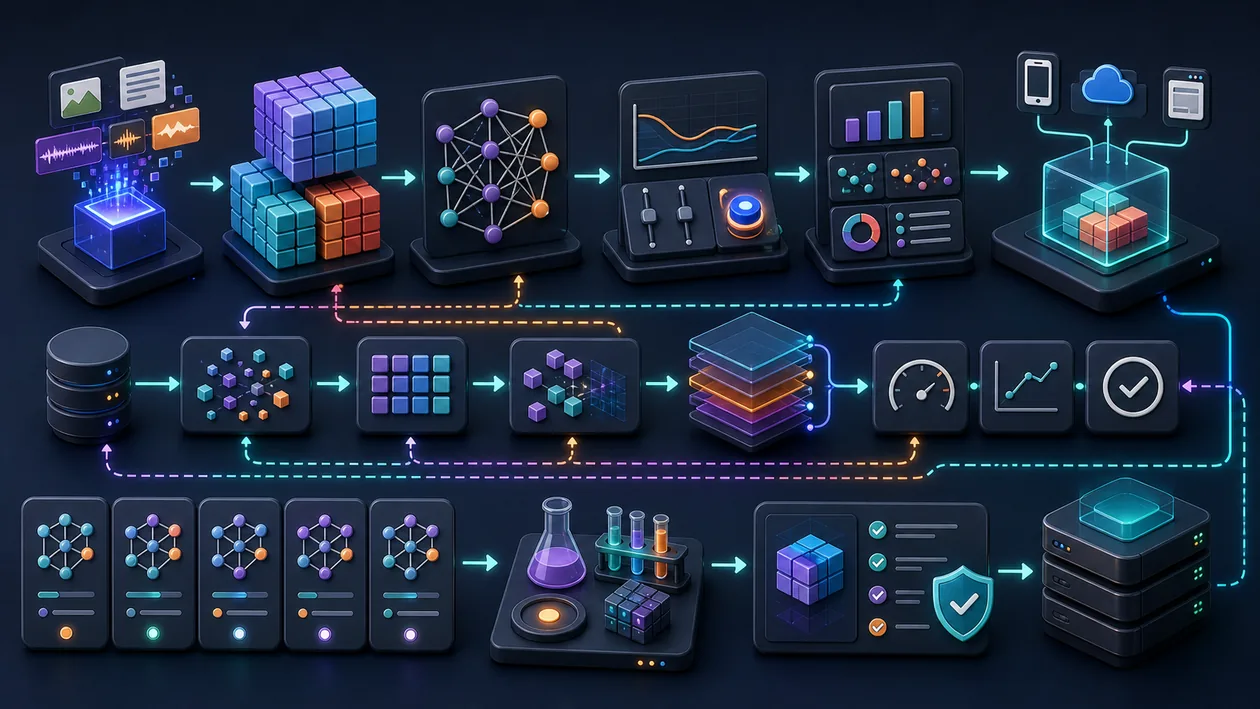
PyTorch is an open-source framework for machine learning and deep learning, used especially in research and the development of AI models. It offers a flexible and dynamic programming environment that makes it possible to build, train, and evaluate complex neural networks efficiently. PyTorch supports both CPUs and GPUs, which makes it attractive for a wide range of AI applications.
Who is PyTorch suitable for?
PyTorch is aimed at researchers, developers, and data scientists who want to build powerful and customizable deep learning models. It is ideal for users who value flexibility in modeling and need rapid prototyping. It is also very popular in academic research because of its intuitive syntax and strong community. Beginners in AI benefit from extensive tutorials and an active user base that makes it easier to get started.
Key Features
- Dynamic computational graphs that enable flexible model architectures
- Support for neural networks with automatic differentiation
- GPU compatibility for accelerated training
- Extensive libraries for computer vision, NLP, and other AI applications
- Integration with Python and seamless collaboration with other ML tools
- Pretrained models and a model zoo for a quick start
- Support for ONNX to export models to other frameworks
- Tools for debugging and visualizing models
Pros and Cons
Pros
- Simple and intuitive API, especially for Python users
- Flexible modeling through dynamic computational graphs
- Large and active community with extensive documentation
- Good performance thanks to GPU support
- Broad range of use cases from research to production
Cons
- Fairly resource-intensive for very large models or datasets
- Less standardized production environments compared with some competitors
- The learning curve can be steep for absolute beginners in deep learning
- Some features are more mature than others depending on the version and platform
Pricing & Costs
PyTorch is fundamentally free to use as open-source software. However, costs can arise from the use of hardware such as GPUs or cloud services, depending on how and where the framework is used. Some providers offer paid extensions or support packages, but the core software remains freely available.
PyTorch Alternatives
- TensorFlow: Another popular open-source framework focused on production and scalability.
- Keras: A user-friendly deep learning API often combined with TensorFlow.
- MXNet: A flexible deep learning framework that is also suitable for distributed training.
- JAX: A Google framework for fast numerical computation and automatic differentiation.
- Caffe: An older but still used framework that is especially suited for image processing.
Open frequently asked questions
FAQ
1. Is PyTorch suitable for beginners?
What should a PyTorch pilot look like?
Start with a bounded process, a small group and a clear success criterion. Check output quality, permissions and handovers before expanding the scope.
Which data should not be processed in PyTorch without review?
Sensitive or confidential content should wait until contract terms, access, storage and deletion controls have been reviewed. Escalate uncertainty to the responsible privacy owner.
When is an alternative to PyTorch the better choice?
Choose an alternative when the need is occasional, a required integration is missing, or administration and cost outweigh the practical benefit.
Yes, PyTorch offers intuitive syntax and many learning materials, but it is best suited for users who already have basic knowledge of Python and machine learning.
2. Which programming language is used for PyTorch? PyTorch primarily uses Python, but it also offers interfaces for C++.
3. Can PyTorch run on GPUs? Yes, PyTorch supports GPU acceleration, which makes training large models significantly faster.
4. Is PyTorch suitable for production use? Yes, PyTorch provides tools for exporting and optimizing models, which make it possible to use them in production environments.
5. Is there a paid version of PyTorch? The framework itself is open source and free. Costs may arise from hardware or cloud services.
6. How does PyTorch differ from TensorFlow? PyTorch uses dynamic computational graphs, which offer more flexibility in modeling, while TensorFlow traditionally uses static graphs and is often considered more production-oriented.
7. Where can I find tutorials and documentation for PyTorch? The official website and numerous community platforms offer extensive resources, examples, and training materials.
8. Does PyTorch support different AI application areas? Yes, PyTorch is suitable for computer vision, natural language processing, reinforcement learning, and many other areas.
Editorial cluster update June 2026
PyTorch is a core infrastructure tool for teams training, adapting or moving research models toward production experiments.
The card should not treat PyTorch like a normal SaaS tool. Model code, data pipeline, experiment tracking, hardware and team capability are the real decision points.
When PyTorch fits well
PyTorch is most useful when the workflow is already named and the team is not only looking for a tool name. For the Utildesk guide clusters, the practical questions are: which task is being prepared, which data is processed, who reviews the result and which alternative is more realistic in the same work context?
Limits and review points
PyTorch gives freedom, not a product guarantee. Without tests, reproducibility, monitoring and MLOps, a notebook quickly becomes technical debt.
Internal comparison points
Useful comparison points in the Utildesk catalogue are TensorFlow, Hugging Face, Scikit-learn, XGBoost. These links keep PyTorch connected to its real cluster of alternatives, risks and workflow roles instead of treating it as a standalone listing.
Editorial Assessment
PyTorch is a defensible choice when a defined workflow, clear ownership and a limited pilot come together. The decision should rest less on a feature checklist than on whether the team can review results, hand work over reliably and respond to change. Our verdict: a good fit for recurring work with an accountable owner; for a narrow or occasional task, a simpler alternative is usually more sensible.