Status on 19 July 2026
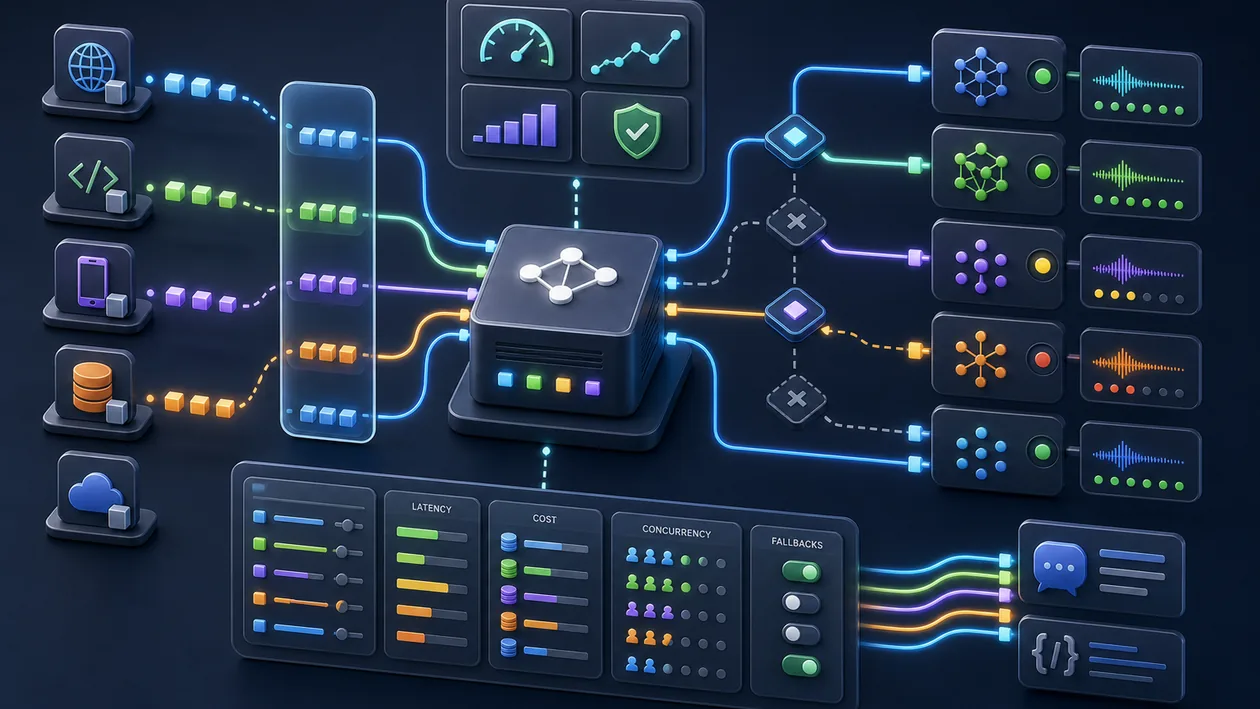
OpenRouter is now more than a model switchboard. The platform has added its own MCP server, a unified image API, and workspace guardrails such as model allowlists, spend limits, PII redaction, and options for stricter data handling. That makes it useful as a controllable platform layer, not merely a prototype convenience.
Routing must remain observable. A production pilot needs an allowed model pool per task, cost ceilings, a documented fallback order, and telemetry for failures and latency. Multiple providers do not remove the need for an outage plan: a fallback can have different quality, data terms, or response behavior.
OpenRouter is a flexible platform for managing and serving AI models, specifically designed to make it easy for developers and businesses to integrate language models and other AI services. The platform supports a range of AI models and provides scalable infrastructure for building your own AI applications.
Who is OpenRouter suitable for?
OpenRouter is aimed at developers, startups, and businesses looking for a straightforward way to integrate AI models into their applications without having to deal in depth with the underlying infrastructure. OpenRouter is especially well suited for teams that want to manage multiple AI models or need a flexible, scalable solution for accessing different AI providers. Researchers and AI enthusiasts who want to experiment with different models also benefit from the platform.
Key features
- Support for various AI models and providers in a single central platform
- API access for easy integration into your own applications
- Management and routing of requests to different AI models
- Scalable infrastructure for high availability and performance
- Ability to customize and extend supported models
- Monitoring and analysis of usage and performance
- Security and privacy through modern authentication mechanisms
- Open-source components for customization and extension
Advantages and disadvantages
Advantages
- Unified interface for different AI models
- Flexibility in choosing the underlying AI providers
- Scalable infrastructure that grows with demand
- Enables easy integration of AI into existing systems
- Open-source elements promote transparency and adaptability
Disadvantages
- Dependence on the availability of external AI models depending on the provider
- Learning curve during configuration and integration
- Pricing and availability may vary depending on the plan used
- Not all AI models and features are included in every version
Pricing & costs
OpenRouter’s pricing can vary depending on the provider, usage, and chosen plan. There is often a free starter tier with limited features and volume, while higher-tier plans offer additional features and more capacity. More detailed information about pricing and possible costs should be obtained directly from the provider.
Open frequently asked questions
FAQ
1. What is OpenRouter?
What should a OpenRouter pilot look like?
Start with a bounded process, a small group and a clear success criterion. Check output quality, permissions and handovers before expanding the scope.
Which data should not be processed in OpenRouter without review?
Sensitive or confidential content should wait until contract terms, access, storage and deletion controls have been reviewed. Escalate uncertainty to the responsible privacy owner.
When is an alternative to OpenRouter the better choice?
Choose an alternative when the need is occasional, a required integration is missing, or administration and cost outweigh the practical benefit.
OpenRouter is a platform for managing and serving different AI models through a central API that makes it easier for developers to integrate AI functionality.
2. Which AI models does OpenRouter support? Depending on the provider, OpenRouter supports various language models and AI services. The exact selection may vary and can usually be customized.
3. How is OpenRouter integrated into your own applications? Integration is usually done via a REST API that enables standardized calls for using the AI models.
4. Is OpenRouter open source? Parts of OpenRouter are based on open-source components, which allows customization and extensions.
5. Is there a free version of OpenRouter? Depending on the provider, there is often a free basic tier with limited features and usage limits.
6. How secure is using OpenRouter? OpenRouter uses modern security mechanisms such as authentication and encryption to help protect data.
7. Can I scale OpenRouter? Yes, the platform is designed for scalable use and adapts to request volume as needed.
8. What alternatives are there to OpenRouter? Alternatives include Hugging Face Inference API, OpenAI API, Cohere, AI21 Studio, and Replicate, which offer similar functionality.
Editorial Assessment
OpenRouter is a defensible choice when a defined workflow, clear ownership and a limited pilot come together. The decision should rest less on a feature checklist than on whether the team can review results, hand work over reliably and respond to change. Our verdict: a good fit for recurring work with an accountable owner; for a narrow or occasional task, a simpler alternative is usually more sensible.
Workflow and rollout
A useful start with OpenRouter begins with one concrete workflow and a small user group. Define the input, expected outcome and manual checkpoint before adding more automation or permissions. Record who approves the result and how a failed step is reversed. A focused pilot makes it clear whether OpenRouter holds up in daily work or only looks convincing in a demo.