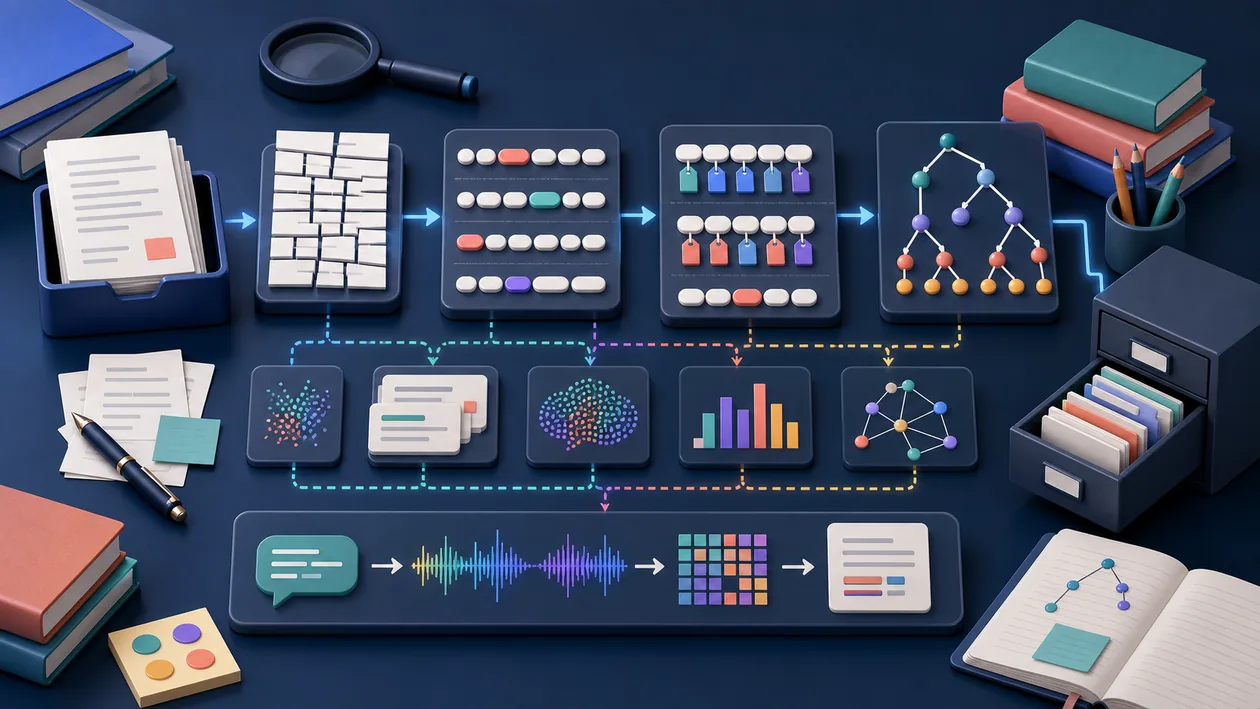
NLTK is a widely used open-source library for natural language processing (NLP) in Python. It offers a comprehensive collection of tools and resources for analyzing, processing, and understanding text. Thanks to its modular structure, NLTK is suitable for both beginners and experienced developers and researchers in the field of language processing.
Who is NLTK suitable for?
NLTK is aimed at programmers, data scientists, linguists, and researchers who work with natural language analysis. The library is especially useful for students and developers who want to learn NLP or build prototype applications. Because of its extensive documentation and strong community, NLTK is also suitable for Python beginners who want to get started with text analysis. For production applications with high performance and scalability requirements, however, more specialized or commercial solutions are often preferred.
Main features
- Tokenization of text into words, sentences, or other units
- Part-of-speech tagging
- Named entity recognition (identifying proper nouns such as people, places, organizations)
- Parsing and syntax analysis of sentences
- Stemming and lemmatization for word normalization
- Support for corpus management and access to numerous preinstalled text corpora
- Tools for sentiment analysis and classification
- Integration of machine learning methods for NLP tasks
- Visualization of syntax trees and other linguistic structures
- Extensive tutorials and learning materials for getting started with NLP
Pros and cons
Pros
- Free and open source with an active developer community
- Extensive collection of NLP tools and corpora
- Well documented and didactically structured, ideal for learning
- Flexible and extensible through Python integration
- Supports many basic NLP tasks out of the box
Cons
- Not always optimal for very large datasets or production systems with high performance requirements
- In some areas, it is outdated compared to newer NLP libraries such as spaCy or Hugging Face Transformers
- The complexity of some modules can be challenging for beginners
- No direct support for deep learning models; integration requires additional libraries
Pricing & costs
NLTK is a free open-source library and can be used without license fees. Since it is a purely open-source project, there are no costs for use or download. Running it only requires a Python environment.
Open frequently asked questions
FAQ
1. What is NLTK?
What should a NLTK (Natural Language Toolkit) pilot look like?
Start with a bounded process, a small group and a clear success criterion. Check output quality, permissions and handovers before expanding the scope.
Which data should not be processed in NLTK (Natural Language Toolkit) without review?
Sensitive or confidential content should wait until contract terms, access, storage and deletion controls have been reviewed. Escalate uncertainty to the responsible privacy owner.
When is an alternative to NLTK (Natural Language Toolkit) the better choice?
Choose an alternative when the need is occasional, a required integration is missing, or administration and cost outweigh the practical benefit.
NLTK is a Python library for natural language processing that provides many tools and data resources for text analysis.
2. Is NLTK free? Yes, NLTK is open source and can be used for free.
3. Which programming language is required for NLTK? NLTK is developed for the Python programming language.
4. Can NLTK be used for machine learning? Yes, NLTK offers basic machine learning functions in the NLP context, but specialized libraries are often more powerful.
5. Is NLTK suitable for beginners? Yes, NLTK is well suited for learning NLP basics thanks to its extensive documentation and tutorials.
6. How does NLTK differ from spaCy? NLTK is more comprehensive and more academically oriented, while spaCy focuses on speed and practical applications.
7. Does NLTK support deep learning models? Not directly; additional libraries are required for deep learning integration.
8. Where can I find documentation and tutorials? The official NLTK website offers extensive documentation and learning materials.
Editorial Assessment
NLTK (Natural Language Toolkit) is a defensible choice when a defined workflow, clear ownership and a limited pilot come together. The decision should rest less on a feature checklist than on whether the team can review results, hand work over reliably and respond to change. Our verdict: a good fit for recurring work with an accountable owner; for a narrow or occasional task, a simpler alternative is usually more sensible.
Workflow and rollout
A useful start with NLTK (Natural Language Toolkit) begins with one concrete workflow and a small user group. Define the input, expected outcome and manual checkpoint before adding more automation or permissions. Record who approves the result and how a failed step is reversed. A focused pilot makes it clear whether NLTK (Natural Language Toolkit) holds up in daily work or only looks convincing in a demo.