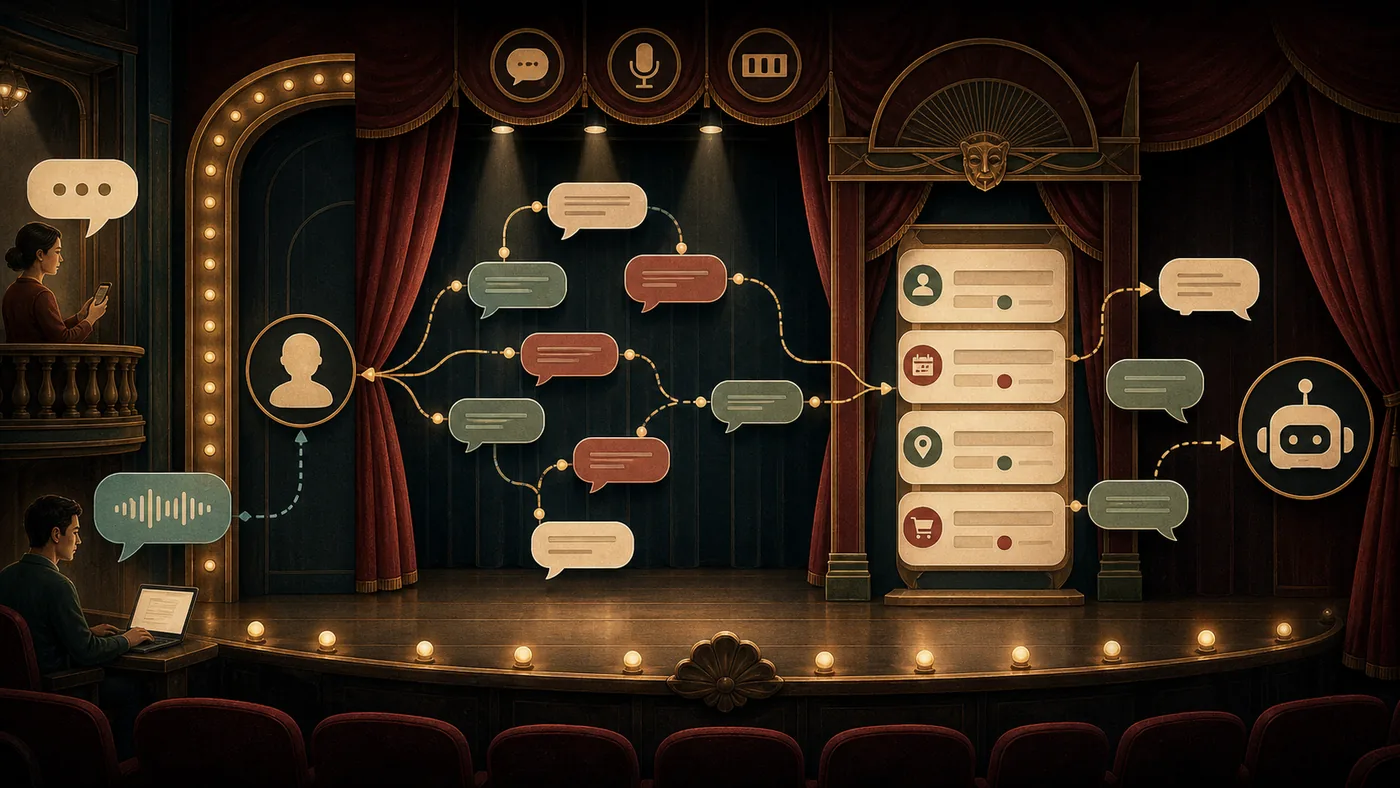
Amazon Lex is AWS's service for building text- and voice-based conversational interfaces. Teams model bots with intents, slots, and dialogue paths, connect business logic through AWS Lambda, and deploy the result to web apps, applications, messaging channels, or a contact centre. The current Lex V2 platform adds AI-assisted capabilities to the classic NLU model, but it remains most useful for controlled conversation flows.
That is different from an open-ended chatbot. Lex is strong when a user needs to complete a task safely: book an appointment, raise a ticket, check a status, or reach the right person. It is not automatically the right answer for arbitrary knowledge questions without carefully maintained sources.
Who is it for?
Lex fits product, support, and platform teams already operating on AWS that want a traceable bot inside an application or Amazon Connect. Good first use cases are bounded self-service requests with a small set of permitted actions and a visible handoff to people.
It is a poor substitute for an unstructured support process. If ownership, specialist knowledge, or authority to decide is unclear, a bot only accelerates the wrong answer. Decide first what the bot must never do or claim.
Core building blocks
- Text and voice: Users can interact through chat or speech; Lex provides ASR and NLU for those interfaces.
- Intents, slots, and dialogue logic: Teams define permitted requests, required details, and controlled branches.
- Assisted NLU: LLM-powered help can improve intent classification and slot resolution while staying within configured bot boundaries.
- Lambda and AWS integration: A dialogue can invoke a reviewed business action such as booking, status lookup, or ticket creation.
- Amazon Connect and channels: Available for contact centres, web, mobile applications, and multiple messaging or voice channels.
- Testing, publishing, and monitoring: Bot versions can be checked against real dialogue cases before broad release.
A sensible pilot
Start with one measurable case, such as a password reset, delivery status, or appointment change. Every response needs a known data source, allowed action, error message, and escalation route. When uncertain, the bot should not guess; it should ask a safe follow-up question or transfer context to a person.
Before launch, build a test set from real, incomplete, and hostile inputs. Measure more than containment: track misroutes, abandonment, time to resolution, and human rework. Run the set again after every product or process change.
Editorial Assessment
Amazon Lex is a strong choice for teams operating conversational automation as a controlled interface to an AWS backend. The combination of dialogue modelling, Lambda logic, and contact-centre context is valuable when responsible teams actually maintain tests and handoffs.
We would not mistake Lex for a virtual employee. Its quality comes from clear boundaries, sound data sources, and reachable human help. High-risk bots and complex advice require approvals, audit logs, and an immediate escape route by design.
Cost, security, and operations
Lex is usage-priced. In request-response flows, text and speech inputs count as API requests; streaming conversations follow a different model. Automated bot design from conversation transcripts also has separate processing cost. Budget for dialogue volume, channels, testing, and the AWS services behind Lambda.
Dialogue data may contain personal or confidential information. Define access roles, encryption, retention, sensitive-field masking, and restricted transcript access before production. A polished bot message is not useful if the action behind it has excessive permissions.
Open frequently asked questions
FAQ
Can Lex answer every customer question freely?
That should not be the goal. Lex is most reliable when intents, data sources, and actions are bounded. Open knowledge answers need additional reviewed retrieval and governance components.
What makes a good first use case?
It is frequent, bounded, low-risk, and ends in a verifiable action or clean handoff. A pilot should not try to solve complaints, cancellations, and complex advice all at once.
What happens with an unclear input?
The dialogue needs a defined follow-up or transfer to a person. Guessing and invented answers are not acceptable error handling.
How can cost be controlled?
Use budget alerts and review text, speech, and streaming usage together with connected AWS services. Model realistic dialogue volume before rollout.