The Work Starts After Launch: How AI Products Find a Way Through the Noise
A launch is not fireworks. For a small AI team, the useful work begins with the questions, comments, and wrong expectations of the first week.

On the morning after launch, a small team looks at two numbers first: visitors and likes. By afternoon, a more dangerous message arrives: “Looks cool, but what exactly does this solve for me?” If nobody can answer that in one sentence, the prettiest Product Hunt image will not rescue the day. The launch has not failed. It has simply shown, honestly, that the product and its explanation do not yet fit together.
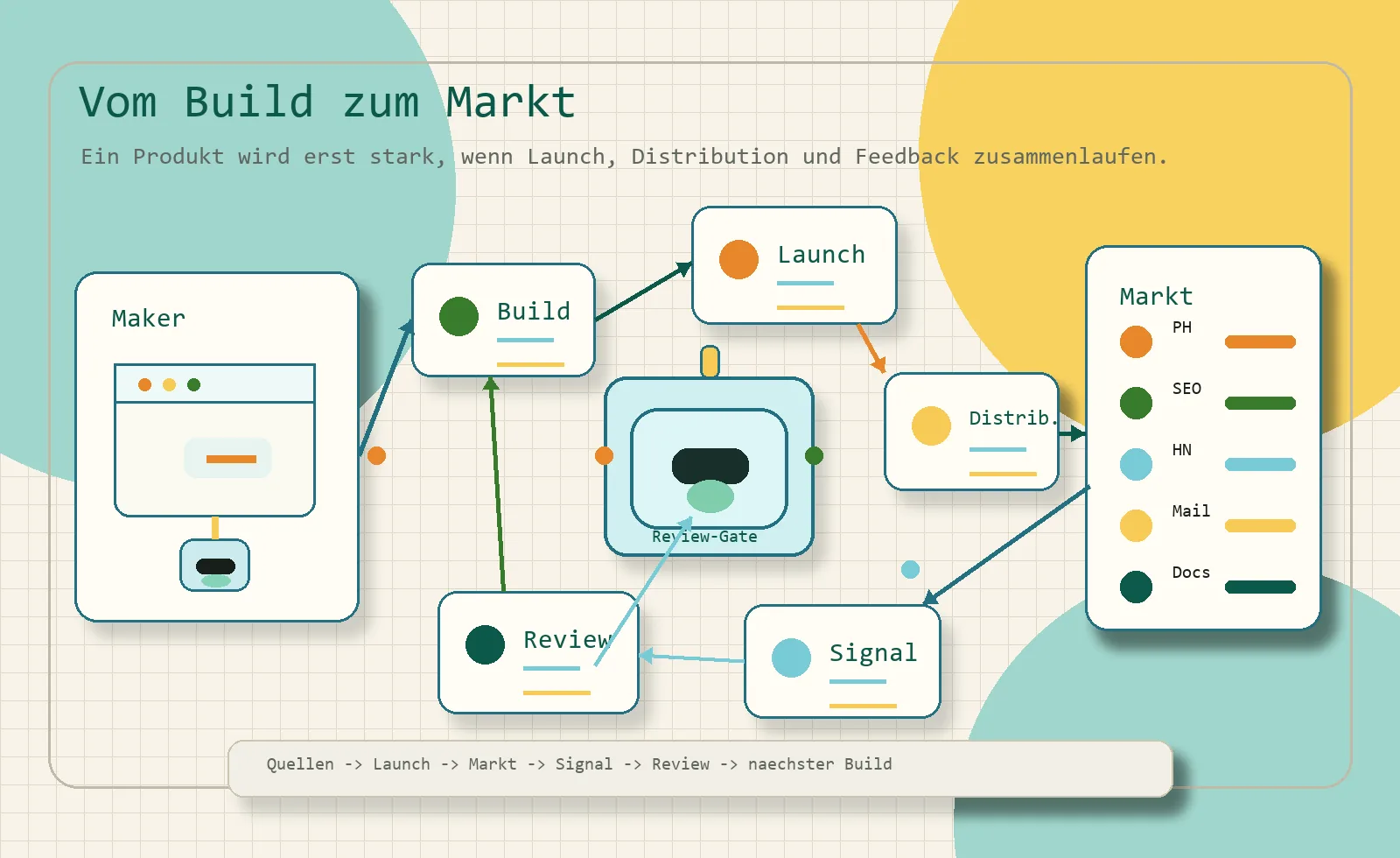
That moment is easy to hide for AI products. It is easy to work through a list of directories, generate tagline variants, and distribute posts across many channels. It is harder to learn from the first conversations who really needs the product and where people drop away. Distribution is not a loudspeaker. It is a return channel for decisions.
The wrong metric makes a launch frantic
A high ranking, a traffic spike, or one hundred sign-ups are not worthless. They do not answer the most important question: did the right people understand what problem the product solves for them?
Product Hunt describes its launch as access to a community and conversation, not a guaranteed sales channel. It also encourages makers to start the discussion themselves; a maker's first comment is part of launch preparation. That is useful guidance well beyond Product Hunt: a launch without conversation creates visibility but little knowledge.
For a small team, three measures are more useful at the start:
- Understanding: Can visitors explain in their own words what the product is for?
- First value: Do they reach a visible useful result in one session rather than only creating an account?
- Return: Do they come back with a real reason, or is launch day their only visit?
These questions are less flattering than a reach number. They tell you whether it makes sense to open the next channel or to work first on the product and its explanation.
Build a landing page that earns a follow-up question
Many AI landing pages begin with the model: “agentic platform”, “intelligent automation”, “AI-native workspace”. That names a category, not a reason to stay. A stronger page begins with a concrete work situation and the change after it.
Not: “Our agent automates research.” Instead: “Before Monday's meeting, five supplier pages become a checkable list of links, changes, and open questions.” The sentence is narrower. That is why it can be tested. When an interested person asks whether it also fits another case, a conversation begins instead of a polite “sounds exciting”.
ChatGPT or Claude can help pressure-test that explanation against objections. They should not simulate the market's voice. Give them real conversation notes, support questions, and abandoned onboarding sessions. Do not ask for ten advertising variants; ask for patterns. Which words do users use themselves? Where do they expect something the product does not do? Which question repeats?
Use the first seven days as a learning loop
The most useful launch plan is surprisingly small.
Day 1: listen. Record each follow-up question verbatim. Separate praise from understanding. “Looks great” is not a product-market-fit signal; “I would use this if ...” is much better.
Days 2 and 3: sort. Do not keep the conversations as a loose pile of screenshots. A shared document, perhaps in Notion, is enough: question, type of person, context, likely cause, and next decision. Perplexity can help check market or competitor claims, but it cannot replace your own observation of users.
Days 4 and 5: change one thing. Do not throw out the entire product. Choose the friction that repeats among the right people: an unclear first step, missing sample data, a misleading pricing question, or an ambiguous term. Change it visibly.
Days 6 and 7: report back. Write to the people whose feedback triggered the change. Not as a bulk email. Show briefly what changed and ask whether it fits their case better. That is support, research, and the beginning of a credible relationship at once.
Automate preparation, not trust
AI can accelerate the mechanical parts of this cycle: cluster comments, sort conversation notes by theme, propose an FAQ, draft explanation variants, or prepare a list of potential publishing locations. It should not post to communities on its own, smooth away objections, or distribute the same generic story everywhere.
That is not merely a question of style. Google explicitly recommends helpful, reliable, people-first content instead of material made primarily to gain rankings. The same is a good operating rule for launches: every public post should answer a question real people have already asked. If it only imitates reach, it will probably be received as noise.
A review gate before every public release can feel slow, but it prevents the expensive form of automation: one hundred carefully sent wrong messages. Record which channel creates which expectation, what may be claimed there, and who gives the final yes.
Launch does not end - it becomes more specific
A product launch has worked when it makes the next decision easier. Perhaps it shows that one group understands the benefit immediately. Perhaps it shows that the product still needs too much explanation. Both are more valuable than a pretty chart with no follow-up work.
The new tool layer after the build is therefore not a magic distribution agent. It is a simple operating system: a clear claim, real conversations, a readable signal, one small change, and a response. Teams that can repeat that process do not build visibility as a one-off event. They get it as a by-product of a better product.